
Stop Scrolling. Your Art Could Be Your Paycheck.
If you’re an artist watching your designs collect dust on your hard drive, you’re leaving serious money on the table. Print on Demand changes the game: no inventory, no upfront costs, no shipping nightmares. You upload your art, someone buys a hoodie or canvas print, and you get paid. That’s it.
Miss this post and you might miss the platform that could turn your side hustle into a full-time income.
I’ve dug through the noise, compared fees, print quality, and real artist success stories for much needed inspiration. Let’s get you selling.
Also Read: Cheapest Print on Demand Sites
Why Print on Demand Is a No-Brainer for Artists?
POD lets you turn one piece of art into 50+ products, canvas prints, apparel, mugs, phone cases, even lamps, without ever touching a box. You focus on creating. The platform handles printing, packing, andshipping. The buyer base is massive too: Etsy alone has 96+ million active buyers hunting for unique, personalized art.
But not all POD sites are equal. Some crush you with fees. Others have awful print quality that makes your work look cheap. Some give you zero branding control. Pick wrong and you’ll work twice as hard for half the profit.
Here are some of the best POD sites to start making money by selling your art and creativity. We’re putting Printful at #1 andPrintify at #2 because, frankly, they dominate for quality + scalability. Let’s break them down.
Best Print On Demand Sites To Sell Art And Make Money
1. Printful
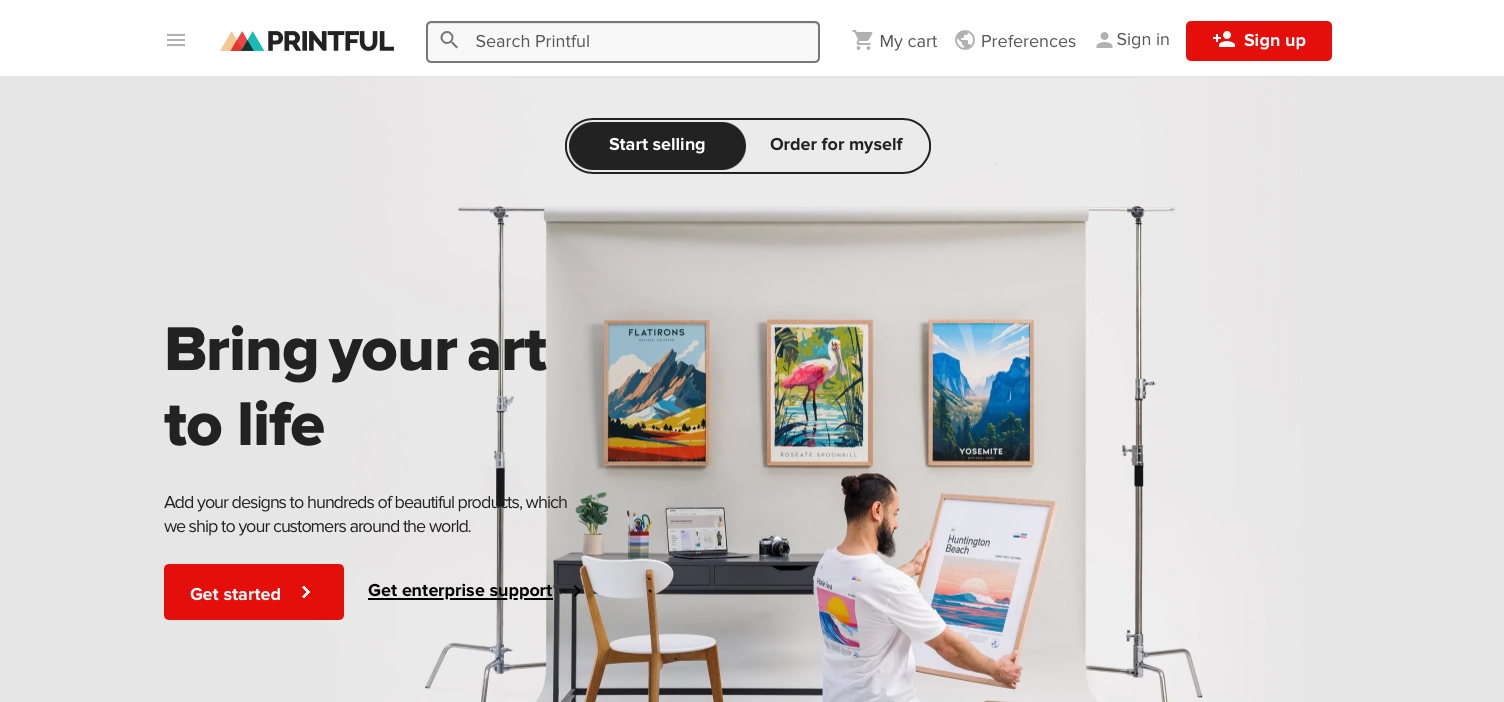
Best for: artists who want premium quality, real branding, and to be taken seriously.
If you’re building an actual brand around your art, not just throwing designs at the internet — Printful is the foundation. They’re one of the few PODs that own most of their fulfillment centers, which is why the quality doesn’t play roulette. Your canvas print from a customer in Texas looks identical to one shipped to New York.
Create & sell your own custom design products online with print-on-demand dropshipping.
Free signup • No order minimums • 258 products
Why artists swear by it?
- Print quality is elite: DTG printing that doesn’t crack after two washes. Canvas prints with solid wood stretcher bars and gallery-wrapped edges. Embroidery that’s actually thick and clean. When someone pays $80 for your art, it better look like $80. Printful delivers.
- Branding that’s actually yours: Custom inside/outside labels, sleeve prints, pack-ins like thank-you cards, and branded packaging. Your buyer unboxes your brand, not a generic “Printful” box. That’s how you get repeat customers.
- 300+ product catalog: Beyond the basics. We’re talking premium posters, framed prints, acrylic wall art, all-over-print hoodies, embroidered beanies, hats, joggers, phone cases, tote bags, notebooks, mugs, towels. If you can dream it, you can probably sell it.
- Design tools that don’t suck: The mockup generator is stupid-good. Drop your art on a lifestyle model, bedroom wall, or flat lay in 10 seconds. No Photoshop needed. It also flags low-res files before you waste money on samples.
- Integrations everywhere: Shopify, Etsy, Amazon, TikTok Shop, Squarespace, Wix, WooCommerce, eBay, BigCommerce, Ecwid. Connect in 5 minutes. Orders, tracking, and customer updates all sync automatically.
- No monthly fees to start: Free plan works for 99% of artists. You only pay base cost + shipping when you sell. Growth plan is $24.99/mo and unlocks 20%+ discounts + branding tools, worth it once you’re doing 50+ orders/mo.
Misses
- Base costs are premium: A Bella+Canvas 3001 tee base is ∼$13.50 vs. $8-9 on Printify. Your margins are tighter unless your brand commands higher prices. You must charge accordingly.
- Shipping isn’t Amazon-fast: 2-7 business days production + shipping. US orders average 4-6 days total. If your buyers expect Prime, set expectations in your store.
- No built-in traffic: Printful doesn’t have a marketplace. You’re responsible for getting eyes on your products. Pair it with Etsy for discovery or run your own ads.
Create & sell your own custom design products online with print-on-demand dropshipping.
Free signup • No order minimums • 258 products
Pro tip: Order samples of your top 3 designs on your hero products. Printful’s “sample order” discount is 20% off. Photograph them yourself. Real photos convert 3x better than mockups, and buyers trust them more. Also use their Warehousing & Fulfillment if you ever want to stock bestsellers for 1-2 day shipping.
Bottom line: If your art is your reputation and you want every customer to feel like they bought from a legit brand, Printful is #1. You’ll pay more per item, but you’ll also refund less, get better reviews, and build something that lasts beyond a trend.
2. Printify
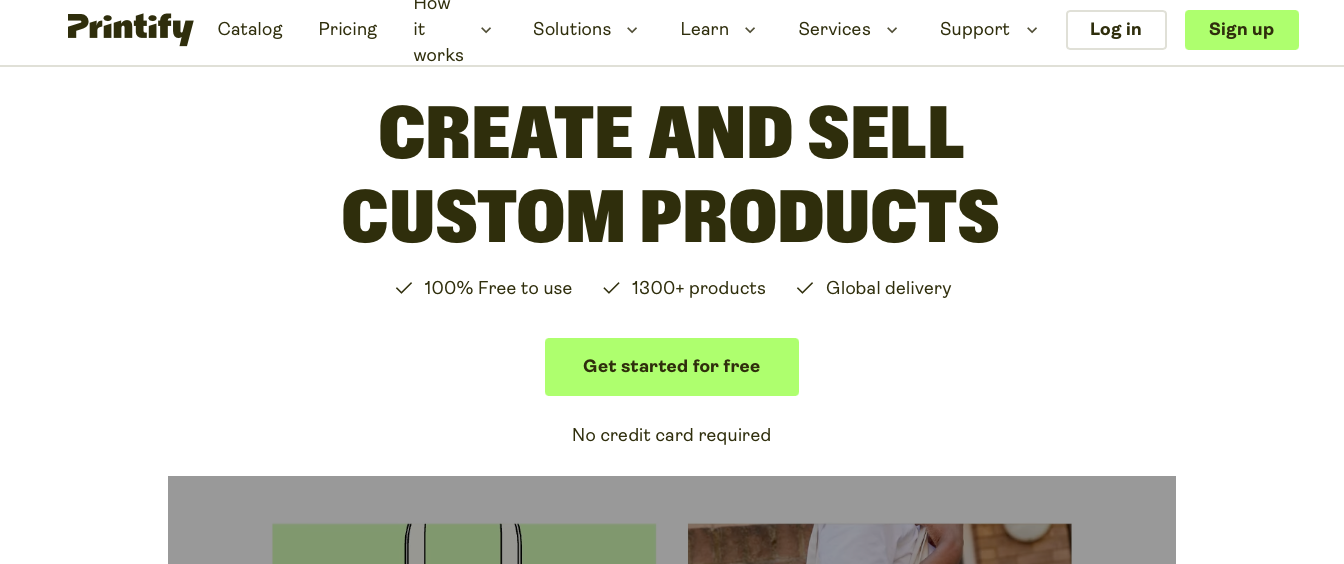
Best for: profit margins, product experimentation, and scaling fast on Etsy.
Printify isn’t a print shop. It’s a network of 90+ print providers competing for your business. That’s chaotic and powerful. You pick the provider per product based on price, location, or rating. Control freaks and margin nerds love it.
Create and dropship Custom Products with your design · 100% free · Easy to use · 250+ products · 90+ print providers.
What makes it stand out?
- 900+ products: The catalog is absurd. Standard tees and canvases? Sure. But also skateboards, bluetooth speakers, jewelry, shoes, clocks, shower curtains, pet bowls, puzzles, garden flags, Christmas stockings. If your audience is niche, you’ll find something weird they’ll buy.
- Margins that make sense: Because providers compete, base costs are usually 15-30% lower than Printful. A Gildan 5000 tee can be $7.50 vs $10+. On 100 sales a month, that’s $250+ back in your pocket. That funds your ad spend.
- Global routing, smart pricing: Sell to a UK buyer? Printify auto-routes to a UK printer to cut shipping time/cost. You can also set different retail prices per country so your margins stay consistent.
- Etsy is its home turf: Printify’s Etsy integration is seamless and they literally publish 2026 strategy guides for Etsy artists. With 96M+ active Etsy buyers, this combo is how art-first creators hit 5-6 figures.
- Premium plan = cheat code: $24.99/mo gets you up to 20% off base costs. If you sell 20+ items/mo, it pays for itself. Serious sellers run Premium from day one.
- Free design tools: Basic mockup generator, AI image tools, and a product creation flow that’s faster than Printful’s. You can launch 50 SKUs in an afternoon.
The catch you can’t ignore
- Quality varies wildly: Provider A might nail colors. Provider B ships your canvas with a dent. You mustorder samples and stick with 2-3 trusted providers. Read reviews in Printify for each product.
- Customer service is on you: If Provider B screws up, you deal with the buyer. Printify helps mediate, but you’re the store owner. That’s ecommerce.
- No branding control: Most providers don’t do custom labels or pack-ins. Buyers know it came from a POD. This is fine for Etsy but hurts if you’re building a luxury brand.
Pro tip: Use the “Printify Choice” badge to let their algorithm pick the best provider per order. But for your top 5 sellers, manually lock in your favorite provider after testing. Also, turn one design into a “collection”, art print, sticker, mug, tee, phone case. Etsy’s algorithm loves shops with depth, and buyers love bundles.
Create and dropship Custom Products with your design · 100% free · Easy to use · 250+ products · 90+ print providers.
Bottom line: Printify gives you leverage. Lower costs, more products, faster scaling. If you’re data-driven, willing to test, and care more about profit than white-glove packaging, this is your workhorse. Most six-figure Etsy art shops run Printify + Printful together.
Also Read: Best POD Sites For Books
3. Fourthwall
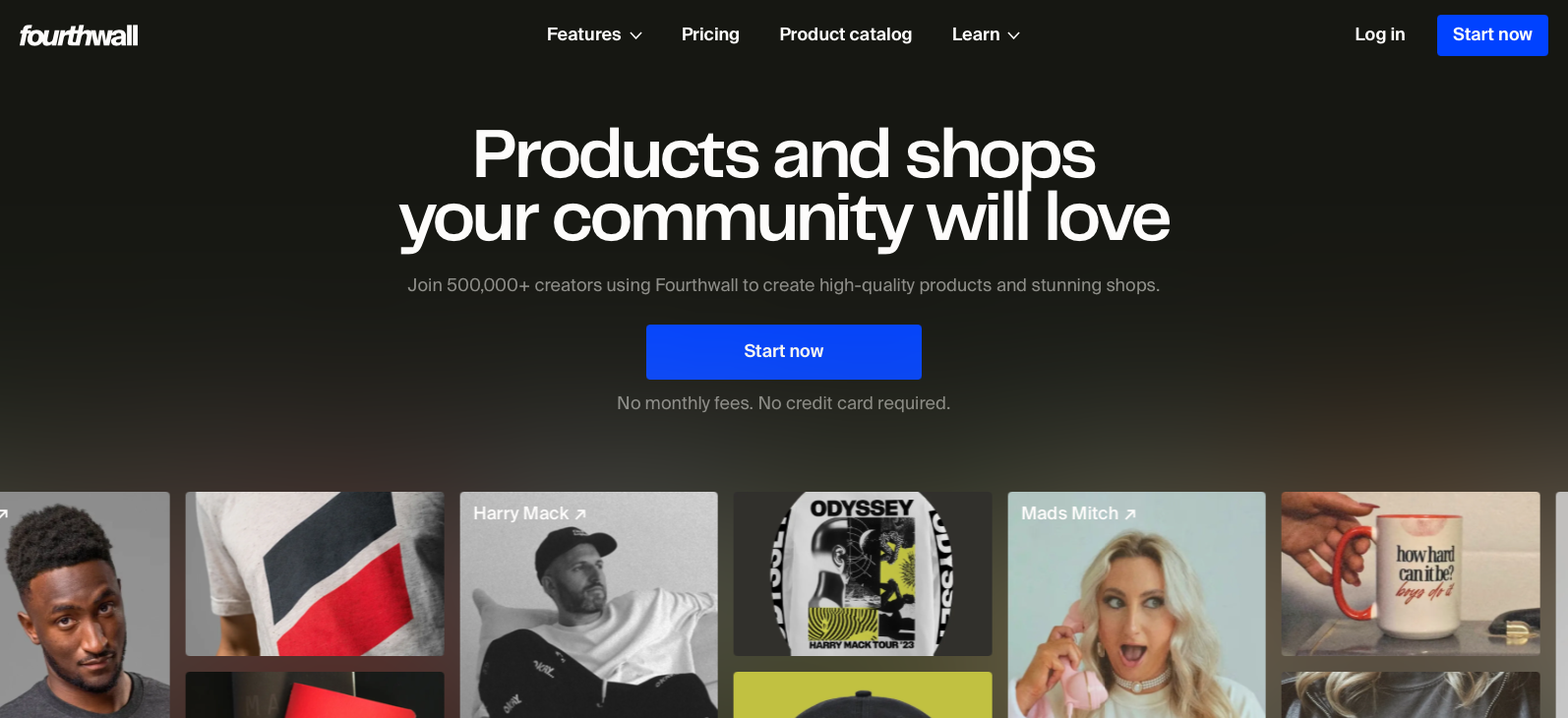
Best for: all-in-one for creator-artists who want merch, memberships, and POD under one roof.
Fourthwall isn’t just POD. It’s what happens when Shopify, Patreon, and Printful have a baby. If you’re an artist with a TikTok, YouTube, or Instagram following, this replaces 4 tools with 1 login.
Why it hits different for creators?
- 370+ POD products + digital downloads: Canvas prints, posters, framed art, stickers, apparel, hats, mugs. But you can also sell your Procreate brushes, coloring pages, or 4K wallpapers right next to them. 100% margin on digital.
- Memberships + donations: Let superfans pay $5/mo for behind-the-scenes, WIP shots, or monthly print discounts. Add a “tip jar” to your store. This is how artists survive algorithm slumps.
- Your own branded site in 10 minutes: No Shopify fees. No theme hunting. Pick a template, add your logo, and you’ve got a pro store at yourname.fourthwall.com or on your custom domain.
- Built-in marketing tools: Email your customers, create discount codes, launch limited drops, see analytics. It’s all native. No Mailchimp or Klaviyo needed until you’re huge.
- Social commerce baked in: Connect YouTube, TikTok, Twitch, Instagram. Sell directly on your link-in-bio. Fourthwall auto-syncs your products to TikTok Shop and YouTube Merch Shelf.
- Zero upfront cost: Free to start. They take a small cut per transaction, but no monthly fee. Fulfillment is handled via UPS/DHL worldwide.
Where does it need work?
- Less POD customization: You can’t do custom neck labels or branded packaging like Printful. It’s a clean Fourthwall box.
- Product mockups are good, not great: They work, but you won’t get Printful’s lifestyle scenes. Use your own photos for hero images.
- Newer ecosystem: Fewer YouTube tutorials and third-party apps vs. Shopify. If you love tweaking, you’ll feel boxed in.
Pro tip: Use Fourthwall’s “Membership” tier to build recurring revenue. Example: $8/mo gets fans a 20% store discount + monthly digital wallpaper. 200 members = $1,600/mo baseline before you sell a single print. That’s rent money while you sleep.
Bottom line: If you’re an artist and a content creator, Fourthwall collapses your tech stack. You can launch merch in the morning, announce on TikTok at lunch, and pay bills with memberships by night. It’s the fastest path from “followers” to “customers.”
4. Fine Art America
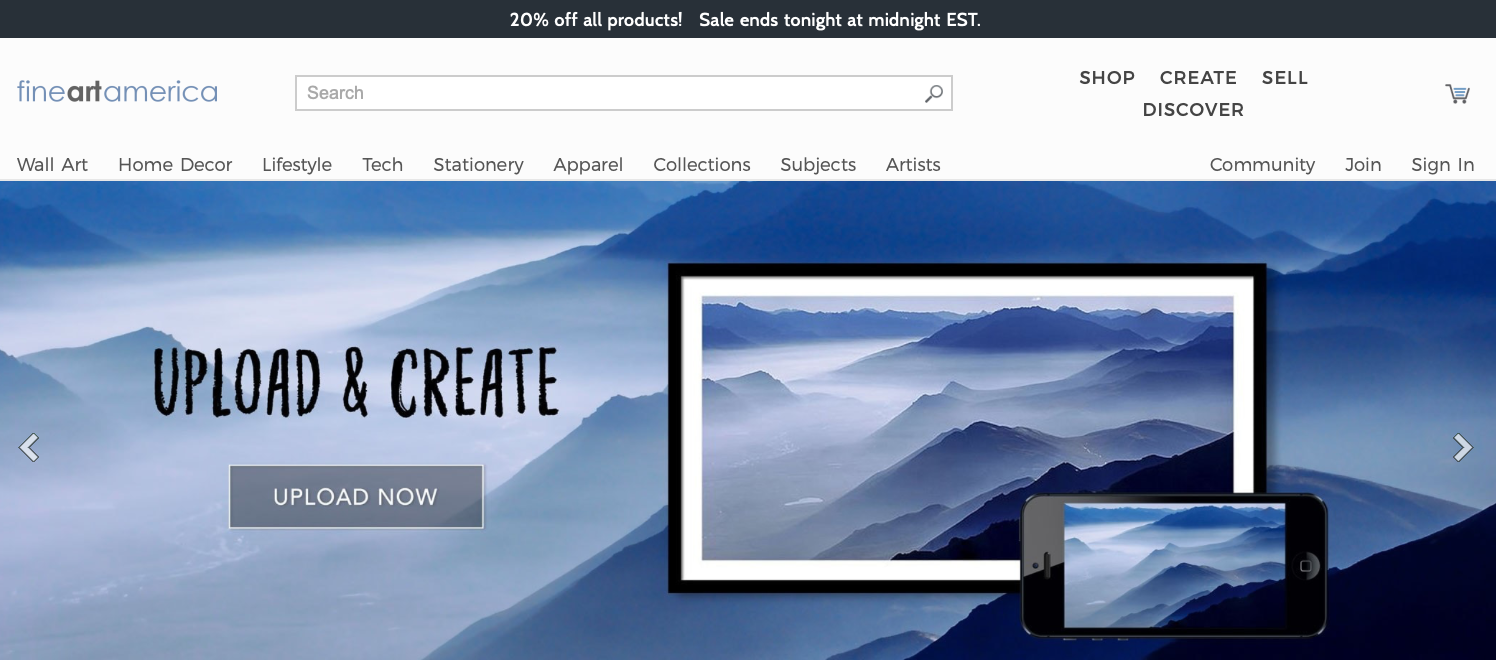
Best for: fine artists, photographers, and illustrators who want to be discovered.
FAA is the closest thing to having your art in a gallery, but online. Buyers come here looking for wall art. They’re not shopping for phone cases, they’re decorating homes, offices, and Airbnbs.
Why serious artists list here?
- Premium product focus: Canvas prints, framed prints, wood prints, metal prints, acrylic prints, tapestries, greeting cards, yoga mats, beach towels, phone cases. The emphasis is on art, not junk.
- You set your markup: FAA sets a base price. You add your artist markup. A 16×20 canvas might base at $65. You add $40. Buyer pays $105. You keep $40. You control profit.
- 16 fulfillment centers: 5 in the US. That means fast domestic shipping and consistent quality. FAA has been doing this for long.
- Retail + licensing deals: FAA partners with retailers and interior designers. Your art could end up in hotels or on a TV set. They also license to products you don’t even offer.
- Shopify plugin: Want your own store later? FAA can fulfill your Shopify orders too. Best of both worlds.
- Free contests + exposure: Weekly contests, curated collections, and a homepage that actually features artists. Win a contest and watch sales spike.
The fine print
- Free vs. Premium: Free account = 25 uploads. Premium is $30/year for unlimited. If you’re serious, pay the $30. It’s cheaper than one Starbucks a month.
- FAA’s cut is real: On a $105 sale with $40 markup, you keep $40. FAA keeps $65 for base + fees. Don’t expect 80% margins. This is a marketplace.
- SEO is work: 500,000+ artists are here. You need great titles, tags, and descriptions. “Blue Painting” won’t cut it. “Moody Abstract Ocean Canvas Print – Navy Blue Coastal Wall Art” will.
- Color complaints exist: Some buyers say colors print darker. Order samples and adjust your files if needed.
Pro tip: Upload your highest-resolution files. FAA prints up to 30×40 inches. A 300 DPI file at 30×40 is 9000×12000 pixels. Blurry files = refunds. Also, enable “Face Masks” and “Weekender Tote Bags”, weird products, but they sell during holidays.
Bottom line: FAA won’t replace your own brand, but it’s the best pure art marketplace left. If you’re a painter, photographer, or digital artist and want passive sales from people who respect art, list here. Let it run in the background while you build elsewhere.
Also Read: Best POD Shoe Companies
5. Redbubble
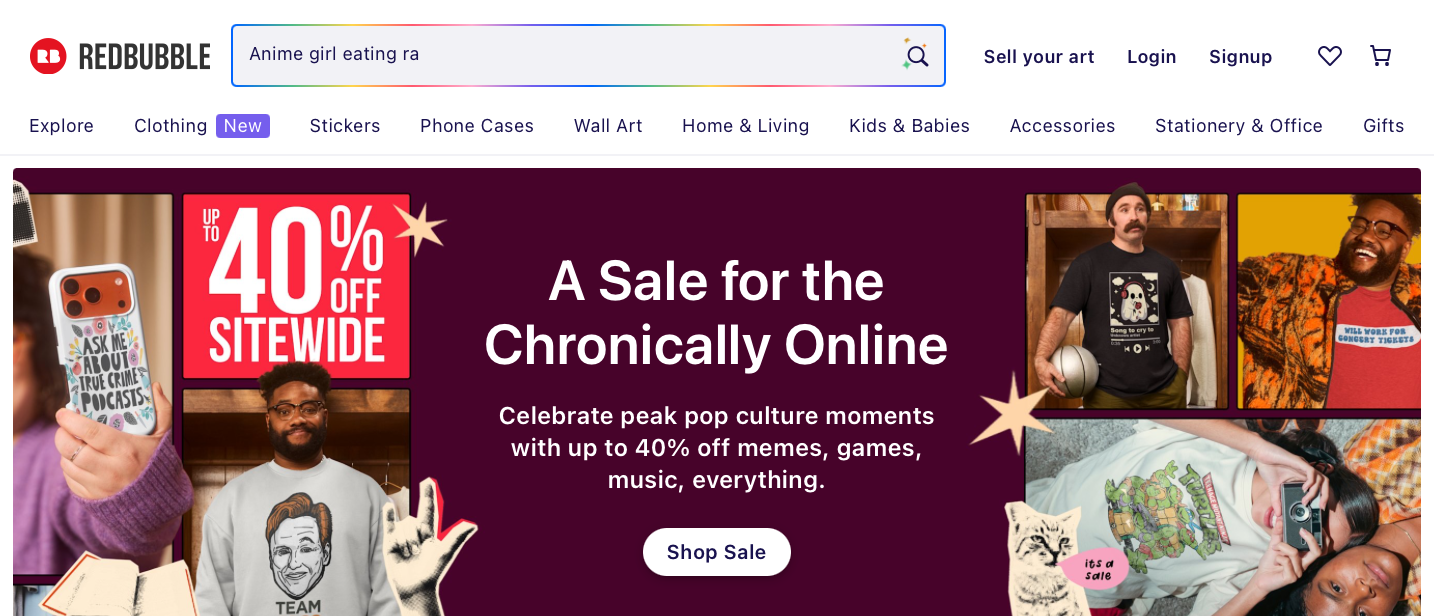
Best for: those who want passive income from graphic, trendy, or fan-inspired art.
Redbubble is the definition of “set and forget.” You upload art, pick products, and their 700,000+ artists and millions of monthly buyers do the rest. You’ll make sales while you sleep — just don’t expect to get rich quick.
Why Redbubble?
- Massive built-in traffic: People go to Redbubble to find weird, specific stuff. “Capybara astronaut sticker.” “Frog playing banjo tee.” If your art is niche, funny, or aesthetic, it gets found.
- Huge product range: 70+ products. Stickers are king, but also clothing, device cases, stationery, wall art, bags, home décor. One design = 70 listings.
- Zero risk, zero effort: No store setup. No customer service. No ads. Upload during your lunch break. Redbubble handles printing, shipping, returns, fraud. You get an email when you make $2.
- Global fulfillment: Orders produce near the buyer. A US buyer gets US printing. An AU buyer gets AU printing. That keeps shipping reasonable.
Watchout
- Margins are thin: Redbubble sets base prices. You add a markup, usually 10-30%. A sticker might net you $0.40. A tee $2-$4. You need volume to make real money.
- Sales culture = discounts: Redbubble runs 20-60% off sales constantly. Your $4 tee royalty becomes $1.60 during a sale. It drives volume but trains buyers to wait for discounts.
- No brand building: Customers buy from Redbubble. They don’t know you exist. No email list. No packaging control. You’re a ghostwriter for their catalog.
- Interface + fee complaints: Artists have reported clunky dashboards and rising fees. It’s not as artist-friendly as it was in 2015, but the traffic is still there.
Pro tip: Think “keywords first.” Before you draw, search Redbubble. If “goblin core” has 200 results and “mushroom frog” has 20,000, draw the goblin. Less competition = faster sales. Also, stickers and tees are 80% of sales. Focus there before making tapestries.
Bottom line: Redbubble is your vending machine. You won’t buy a house with it, but you might pay your Spotify and Adobe bill each month without lifting a finger. Use it to monetize doodles, test trends, and earn passive cash while you build your real brand on Printful or Shopify.
6. TeePublic
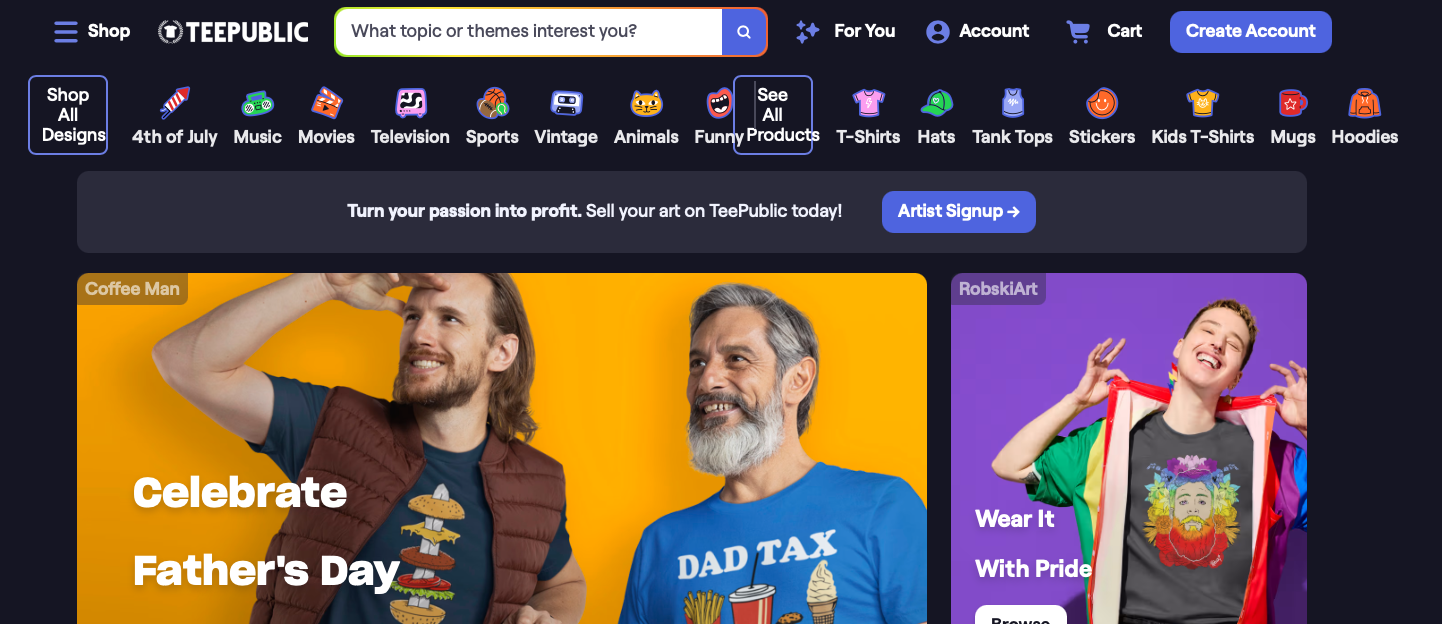
Best for: Pop-culture, fan art, memes, and bold graphic styles that thrive on volume.
TeePublic is Redbubble’s rowdier sibling. Same idea, upload once, they handle everything, but the audience skews younger, trendier, and obsessed with apparel. If your art style is loud, funny, nerdy, or tied to internet culture, this is your playground.
Why artists keep using it?
- Built-in buyer base: Millions of shoppers come to TeePublic specifically for t-shirts, hoodies, and tanks. Your designs get discovered without you running ads.
- Dead simple upload: One file gets placed on 20+ products. No manual mockups needed. You set prices above the base and collect the difference.
- Sales = visibility: TeePublic runs sitewide sales constantly — $14 tees, $10 stickers. That’s annoying for margins, but it trains buyers to impulse-buy. Volume can make up for it.
- Artist community: Easy to get featured in themed collections if your work fits a trend. They also let you import designs directly from Redbubble to double-dip.
The brutal truth
- Discount culture kills margins: When TeePublic forces a $14 tee sale, your $4 royalty doesn’t stretch far. You have to play the volume game.
- Product catalog is limited: Apparel first, everything else second. Canvas prints exist, but they’re not the focus. Forget embroidery or premium home goods.
- Zero branding: Buyers think “I got this from TeePublic.” They’ll never know your name unless they hunt. No email list, no packaging control.
Pro tip: Use TeePublic to test jokes, trends, and graphic designs. If something goes viral, move it to your Printful/Shopify store where you control pricing and keep 100% of the customer relationship.
Bottom line: TeePublic won’t build you a legacy art brand. But if you want passive, hands-off beer money from witty or fandom art, it’s stupid-easy. Just don’t rely on it as your only income stream.
Check Out: Best POD Tshirt Companies
7. Gooten
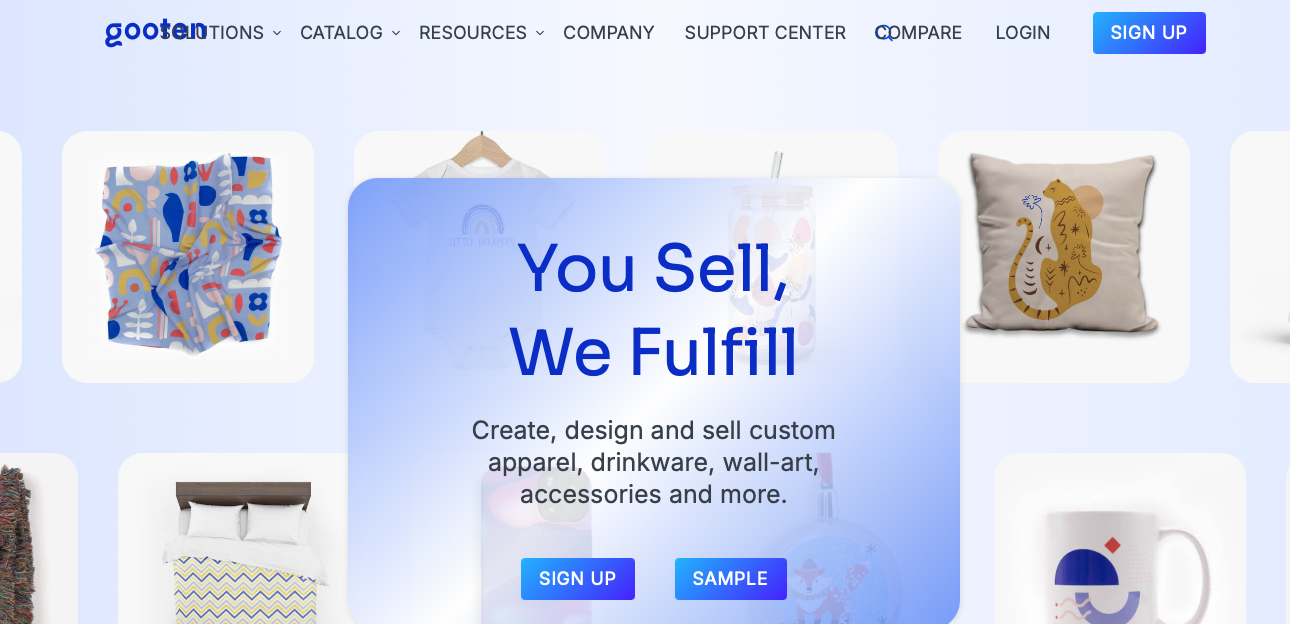
Best for: Artists who want weird, scroll-stopping products your competitors don’t have.
Gooten is like Printify’s eccentric cousin. It’s also a print network, not a printer, which means it connects your store to dozens of fulfillment partners worldwide. The difference? Gooten hunts for unusual products.
Why it’s worth a look?
- Product catalog is wild: Clutches, glass cutting boards, yoga mats, Bluetooth speakers, barware, pet beds, sequin pillows. If you sell art that fits lifestyle/home niches, you can turn one design into gifts people can’t find on Amazon.
- Competitive base costs: Because partners compete, you can often beat Printful’s prices on standard items like mugs and tees. That’s real margin back in your pocket.
- Global routing: Gooten auto-selects the cheapest/fastest fulfillment partner based on your customer’s location. US buyers get US printers. That cuts shipping time vs. shipping everything from Latvia.
- Integrations that matter: Shopify, Etsy, WooCommerce, BigCommerce. Orders flow in automatically. No manual copy-paste.
Watch out for
- Quality roulette: Like Printify, your print quality is only as good as the partner assigned to that order. You must order samples from your top sellers. A “matte poster” from one partner might be glossy from another.
- Dashboard isn’t as slick: Printful’s mockup generator and branding tools are years ahead. Gooten’s interface is functional but feels dated.
- Fewer integrations: No TikTok Shop or Amazon support yet. If you’re omni-channel, you’ll feel it.
Pro tip: Use Gooten to experiment. See a weird product you’ve never offered? List it with zero risk. If it sells, great. If not, delete it. Artists in home décor, pet, and wedding niches have broken out here because the catalog lets them niche down hard.
Bottom line: Gooten is a specialist tool. Don’t make it your only POD, but add it to your stack when you want to offer something truly different and keep costs lean.
8. Society6
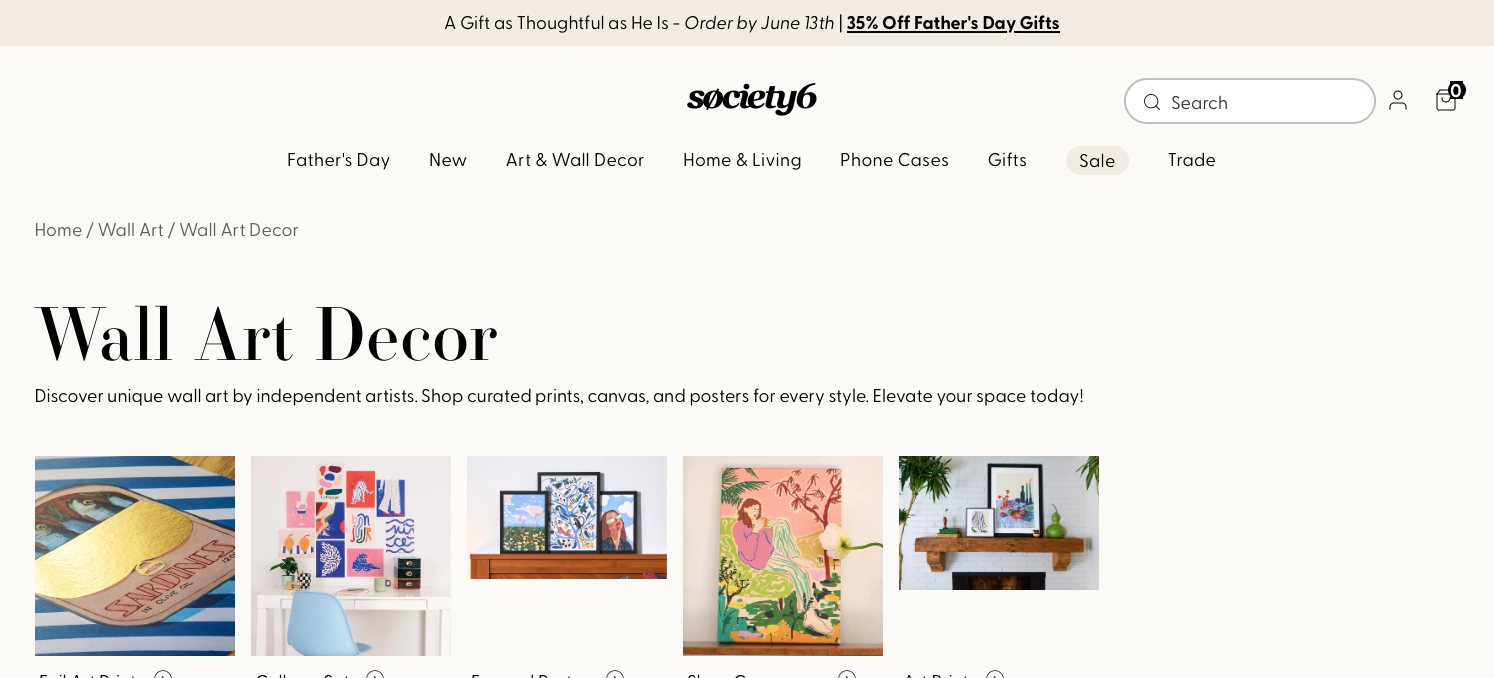
Best for: Illustrators + designers who want their art on premium home décor without lifting a finger.
Society6 built its name as the “artsy home goods” marketplace. Think Urban Outfitters meets an art gallery. Buyers come here expecting to spend $40+ on a shower curtain or credenza with legit artwork on it.
What makes it attractive?
- Curation vibe: Society6 feels more “gallery” than Redbubble’s flea market. That attracts buyers who value design and pay more for it.
- Insane home décor range: Framed prints, tapestries, credenzas, side tables, duvet covers, bath mats, rectangular pillows, outdoor pillows. If your art works on walls and furniture, you’ll print money.
- 100% hands-off: You upload art, tag it, and walk away. Society6 handles production, shipping, customer service, returns. You get a monthly royalty check.
- Community + promos: They run artist challenges, curated collections, and sitewide sales that drive traffic. Getting featured can 10x your month.
The reality check
- You don’t set prices: Society6 sets base prices. You earn a 10% default royalty on most products, with options to mark up art prints. A $65 framed print might net you $6.50. Volume is everything.
- No customer data: Like all marketplaces, buyers belong to Society6. You can’t email them, retarget them, or sell to them again.
- Competition is fierce: Thousands of artists, many with 5+ years of SEO and sales history. New uploads can get buried fast.
Pro tip: Treat Society6 as your “licensing” channel. Upload your best, most decor-friendly work and let it earn passive royalties. Then drive your superfans to your own site where margins are 4x higher.
Bottom line: Society6 won’t make you rich overnight. But if your style fits modern home/interiors and you want truly passive income from people decorating apartments, it’s one of the best marketplaces left.
9. Zazzle
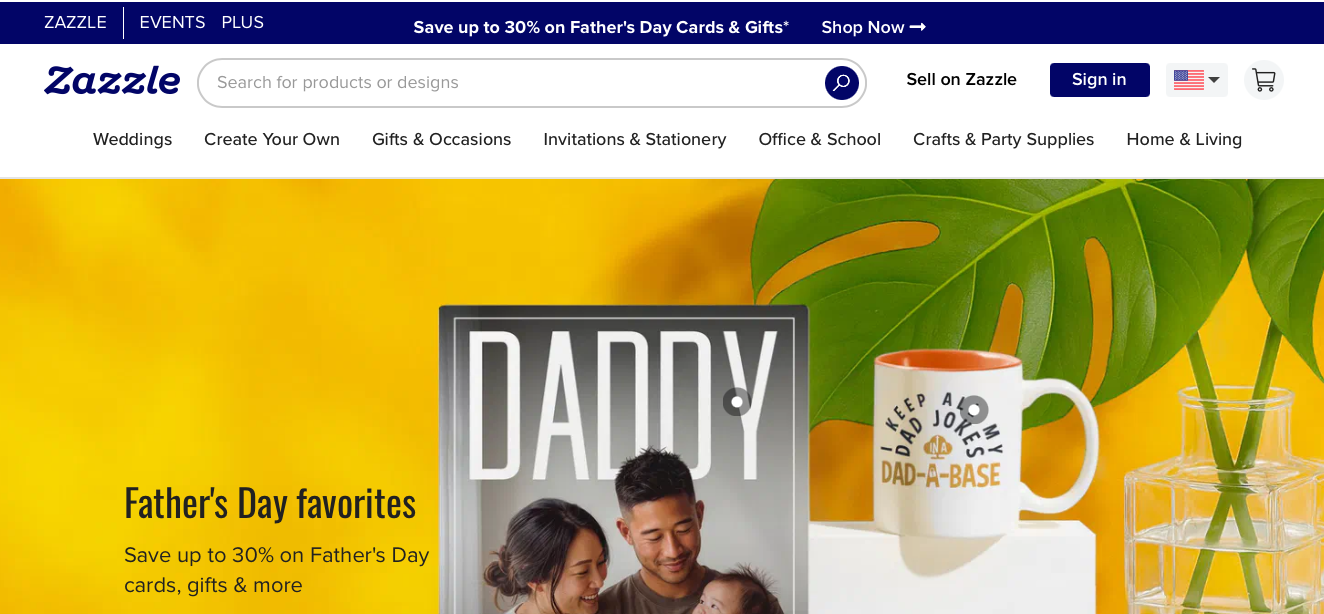
Best for: Customization-heavy art, invitations, weddings, and products people personalize
Zazzle is the OG of “make it yours.” While other PODs print your static design, Zazzle lets customers edit your template. Add names, dates, colors, photos. That’s why it dominates weddings, parties, and corporate gifts.
Why it prints cash for the right artist?
- You control royalties: Set your royalty from 5% to 99%. Most designers run 10-15% to stay competitive, but on a $200 custom canvas you could pocket $30. You choose.
- Customization = higher AOV: Buyers pay more for personalized items. Wedding invites, baby shower decor, business branding kits — all big-ticket sales.
- Massive built-in traffic: 30M+ unique visitors per month, many with buyer intent. People go to Zazzle to make something, not just browse.
- Product depth: 1,300+ products. Paper goods, office supplies, skateboards, shoes, fabrics. If it can be printed, Zazzle probably does it.
The headaches
- Learning curve: Setting up customizable templates takes work. You’re not just uploading a PNG — you’re designing fields, fonts, and options.
- Race to the bottom: 30M products means brutal competition. New stores get buried unless you nail SEO tags and niche hard.
- Zazzle’s cut is high: Even at 15% royalty, Zazzle keeps the rest. Plus they discount aggressively, which can shrink your take.
Pro tip: If you do lettering, watercolor florals, monograms, or anything event-related, Zazzle is non-negotiable. Brides will pay $3 per invite. Sell 200 invites for one wedding and that’s $90 to you for one design. Scale that across wedding season.
Bottom line: Zazzle is work upfront, money later. It rewards designers who think in templates and love the wedding/party/personalization niche. Ignore it if you only sell wall art.
Check Out: Best POD Sites For Etsy
10. Gelato
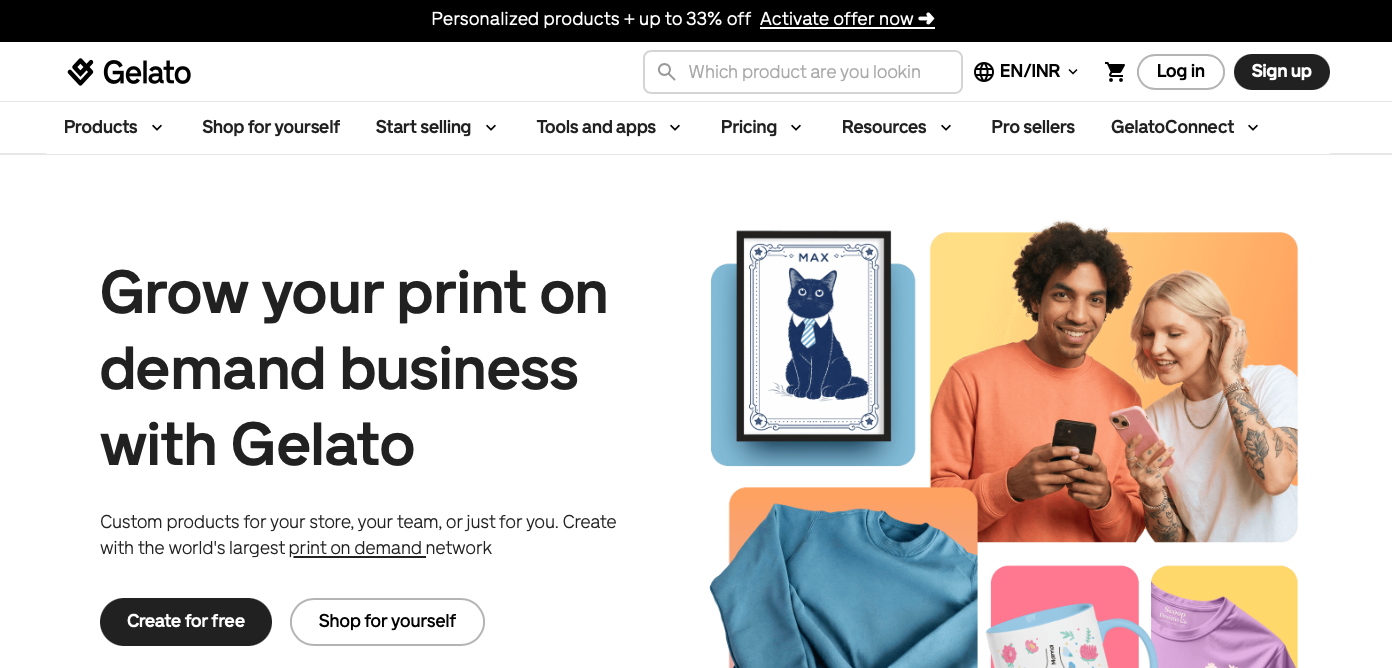
Best for: artists who sell worldwide and are tired of losing customers to $25 shipping fees
Gelato’s entire pitch is “local production, global scale.” They’ve built a network of 130+ print partners in 32 countries. When a buyer in Germany orders your poster, it prints in Germany. When a buyer in California orders, it prints in California.
Why that matters for you?
- Faster shipping = happier buyers: US to US is 2-5 business days. US to EU via traditional POD can be 2-3 weeks. Faster shipping = fewer refunds + better reviews.
- Lower shipping costs abroad: International buyers won’t get slammed with customs fees because items produce locally. That opens up the EU, UK, AU, and Canada for you.
- Quality is surprisingly solid: Gelato vets partners hard. Paper weights, color accuracy, and packaging are on par with Printful for wall art. Apparel is Gildan/Bella+Canvas quality.
- Carbon-neutral option: Gelato calculates and offsets shipping emissions. If your brand is eco-conscious, that’s a marketing win.
- Integrations: Etsy, Shopify, WooCommerce, Wix, Squarespace, BigCommerce. Plus an API if you’re fancy.
The trade-offs
- Smaller catalog: ∼100 products. Tons of wall art, books, apparel, mugs. But no weird stuff like Gooten. No embroidery like Printful.
- Mockups are basic: Functional, but not as beautiful as Printful’s lifestyle scenes.
- Pricing complexity: Because production is local, your profit per country varies. A poster might net you $8 from a US sale but $5 from a UK sale.
Pro tip: If 20%+ of your traffic is international, Gelato will save your conversion rate. Test it by connecting Gelato to your Etsy shop and comparing international sales before/after. Many artists run Printful for US, Gelato for everywhere else.
Bottom line: Gelato isn’t the flashiest, but it’s the smartest choice if you’re serious about global sales. Local production is the future of POD, and Gelato’s already there.
Quick recap for the skimmers
Printful is the best. Printify second best.
Many 6-figure artists use both. Printful for canvases + embroidered gear. Printify for stickers, mugs, and testing new products cheap. You don’t have to marry one platform.
#6-7 are for volume and weird products. #8-9 are marketplaces that pay you while you sleep, but at lower margins.
#10 is your secret weapon for going global without the shipping nightmares.
Stack them smart. Use Printful/Printify as your core, then add one or two of these last 5 to fill a specific gap. TeePublic for memes, Gooten for glass cutting boards, Society6 for home décor, Zazzle for weddings, Gelato for international.
That’s how you build a real art business, not just a POD hobby.